Re-gaining the Ecological Futures: An Environmental Sustainability Fieldwork Study, Fort Kochi, Kochi, India
The study was part of my master’s degree program in Urban Ecological Planning at NTNU University in Norway. It was carried out at Kochi, a city in southern India. The effort was supported by funding from NTNU. Our team included students from Norway, France, Bangladesh, and South Africa.
We conducted this research in Fort Kochi’s Kunnumpuram neighborhood, and it helped us in understanding the larger challenges and structures that affect the entire city and the Global South as a whole, given that India’s southern states have been impacted by rapid growth, privatization, globalization, and the effects of climate change. The site we investigated had urban environmental challenges, making it less livable.
Location:
Kunnumpuram, Fort Kochi, Kochi city, India
Team:
Eloïse Redon
Maria Magdalena Mühleisen
Nahida Yeasmin Tonni
Role
Data collection in stakeholder meetings and participatory workshops, creating the video and different part of the presentations, creating different visualization and post productions, writing down different parts including the parts about the public spaces, waste management, etc. working on the final report in Adobe InDesign.
Timeline
4 Months
Date Completed
December 2022
The outcomes of the research
Our report touched upon the question of governance, which was a big challenge in the area. Co-governance and local action groups have to be implemented to give more ownership to the community and get an effective maintenance system to keep the area pleasant. The improvements in the area will be closely linked to the improvement of the city in general, as many of the challenges on a small scale are related to a broader system.
Overall, the main issues we noticed on site were concerning the waste management system, the lack of public spaces, the gender inequalities and the threat to the environment. Those four challenges are closely linked together and finding answers for one would help for the improvement of the others as well. The public spaces would therefore become the support of our spatial solutions. To tackle those challenges, we set up three goals :
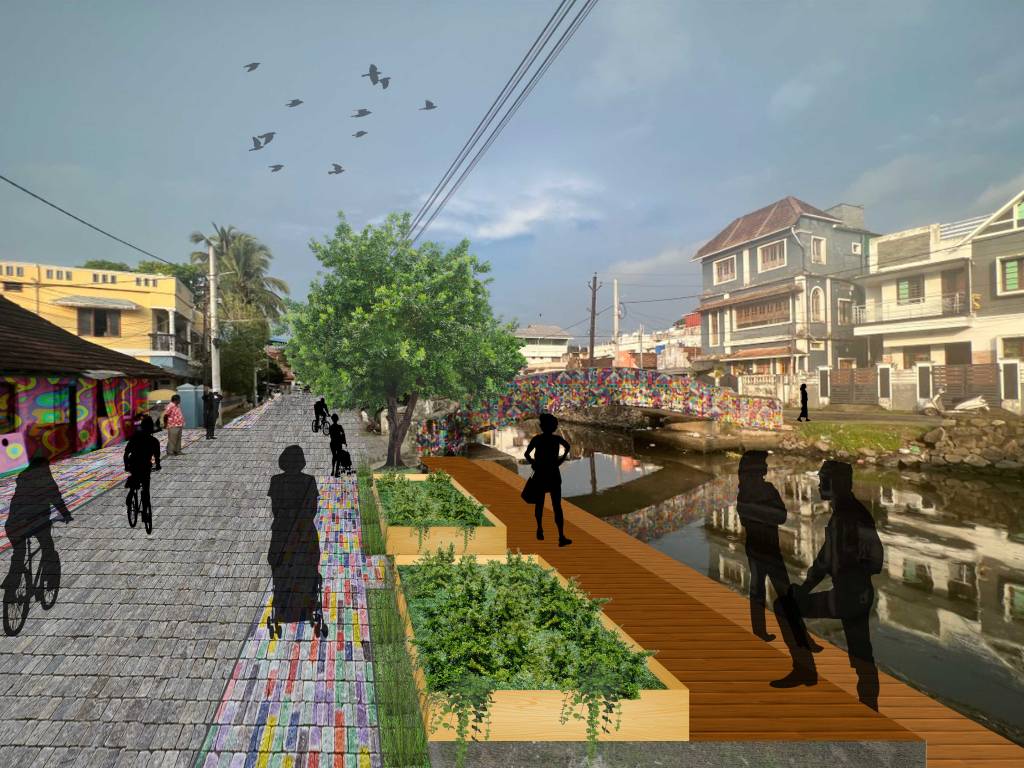
The first one is to create inclusive vibrant public space, that are safe and encourage gender equity. This will be made by implementing safe walkable pathways around the neighborhood, create public spaces using pocket spaces on the streets, establish communal water taps and implement community gardens.
The second goal is to have a segregative waste management system with shared waste bins that creates a social and environmentally sustainable neighborhood.
And the third goal is ecological regeneration, that comes with the canal revitalization and green rewilding. The aim is to have long term social and environmental strategies that involves the
community in every step. The spatial solutions are all together working towards creating a shared context of meaning for the community, creating purpose, equality and justice.
Those spatial solutions couldn’t be implemented without a great governance structure that helps for the creation and maintenance of the solutions. We identified relevant stakeholders that would be the most relevant to contribute and created some community groups to give ownership and a voice to the locals of the neighborhood.
And the final word
The work that we have done here is just a preview of what could be done in a neighborhood, as an example of a Global South city. Kunnumpuram has a lot of challenges but also the capacity to become a thriving, resilient, and inclusive community. With the suggestions of spatial solutions and governance structure, we only touched upon the surface of the issues and possibilities. A more extensive research following the PLA method and involving the community in every step of the reflection would be valuable for the community and could have a real and meaningful impact on the area.
 M. Reza Movahedi